

DIG THIS! Green Ramblings from GBG

California Native Plants and the Approach of Summer

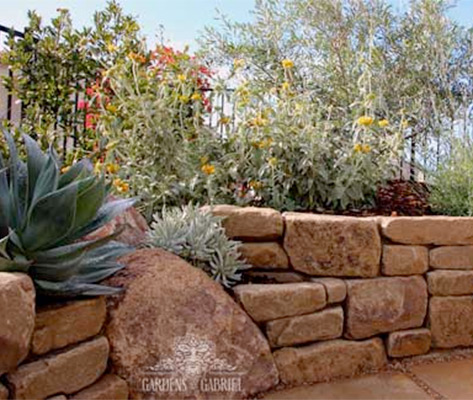
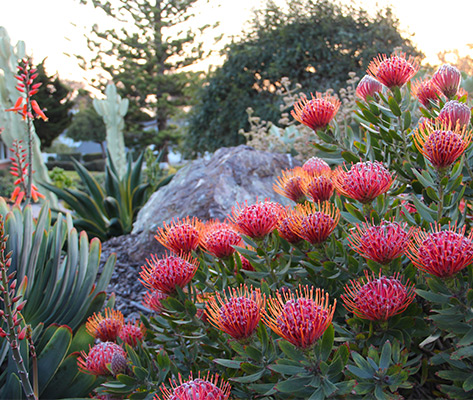
san luis obispo native garden California native plants are known for their vibrant winter blooms, but also for their summer dormant season and for this reason are sometimes overlooked for Mediterranean gardens. It is possible to maintain a beautiful and water-wise garden year-round that includes California natives; all it takes is some strategy.

Planning:
When they’re young, California natives can be treated like other plants in a cultivated garden: They need regular watering to establish a healthy root system. As natives grow to maturity at 5-10 years, you have two choices.

1. Embrace Dormancy:
If you water them less and let them go dormant, your plants won’t be as stressed by root rot and fungal outbreaks, and in general will live longer. With that in mind, combine grasses, succulents, shrubs, and trees whose color and texture vary throughout the year. Design your garden with a plant palette diverse enough to feature the seasonal peaks of certain plants while covering for those that take a break.Mediterranean Meadow

2. Irrigate:
Many Mediterranean and California native cultivars are now adapted to well-placed and well-timed summer irrigation. In order to not stress the plants, however (because too much water or nutrition is just as stressful as not having enough), it is important to carefully place and test every drip emitter. Making sure emmiters are spaced out from the plant crown will encourage wide root growth into the native soil, and discourage rot due to stagnant water. With the consistent encouragement of drip irrigation, most native trees and shrubs will dig their roots deep into the soil, find water, and thrive year-round.

Templeton_mediterranean_stonework

As we embark on our passage through Spring and the last months of our unique growing season, enjoy your thriving garden and the natural landscape around us. Take in the lushness of the grasses, enjoy the vibrant colors in the succulents, watch the poppies and other annual flowers express their beautiful colors–and get ready to dial in your irrigation timers!


Succulent Senecio

Happy coastal growers, Senecio are one of the most forgiving succulents when it comes to propagation. It’s time for us to start a new batch, so we’re going to take you through it step-by-step.


In order to start a new crop, clip the last 5″ of a plant that is doing well.


You’ll see that some of the “leaves” are quite close to the cut–these few should be removed. Snap these off and drop them in your compost pile.


You’ll be left with a cluster of leaves at the end and a 1.5 inch stalk.


Once you’ve amassed a collection, stack them on your potting bench.


Plop the newly-exposed stalks into a receptacle with at least 2″ of soil mix (we combine our home-grown compost with a little pearlite).


Water them in, keep them warm and safe, and wait for their roots to grow!


Tags: , , , , , , ,

Water Conservation Sweeping The Nation!

…Starting with our own KCBX!

Many thanks to Mike Bush of the San Luis Obispo Botanical Garden who, during his January 25th, 2012, interview on KCBX, mentioned a garden we completed with water conservation champion Mary Wilhelm. We were happy to be able to feature Mary’s garden in an article with the Tolosa Press, highlighting that due to her efforts to reduce her water usage, she hadn’t watered her garden at all during 2011. Take a listen to the SLOBG’s Executive Director as he discusses upcoming SLOBG events, signature qualities of Mediterranean climates, and the future of our inspiring local garden:

Mike Bush SLO Botanical Garden KCBX Interview 


Tags: , , , , , , , , ,

Barrel-Free Rainwater Harvesting in SLO County

Leonardo da Vinci said, “Water is the driving force of all nature.”

Rainwater harvesting might not be for everyone, but there are still ways to lessen rainwater runoff. We routinely use and recommend Bioswales to remove silt and pollution and slow the water for better ground absorption. A bioswale is the use of mounded earth to create a drainage course, which slows the water’s path and maximizes filtration. Thick layers of mulch and creative uses of earth also can be designed for the water to slowly sink back into the ground. (Ever rough up your nails before you apply that layer of glossy nail polish? Same thing!)

You may be wondering if rainwater harvesting is OK to do in San Luis Obispo County:

“City of San Luis Obispo 2010 Construction and Fire Code Amendments page 25: 1101.2.1 Rainwater Harvesting. Storm water drainage may be directed to an approved rainwater harvesting system and used an al alternate source of water for non-potable uses as approved by the building official and the San Luis Obispo County Environmental Health Department. The installation and use of such a system or systems must be designed to not interact with the potable water system, the building sanitary sewer or drainage systems that flow to any creek. Rainwater harvesting systems must be maintained in such a manner as to not cause damage to neighboring properties.”


Rainwater Harvesting Around the World:

· Currently in China and Brazil, rooftop rainwater harvesting is being practiced for providing drinking water, domestic water, water for livestock, water for small irrigation and as a way to replenish ground water levels.

· In Tamil Nadu, India, rainwater harvesting was made compulsory for every building to avoid ground water depletion.

· In Bermuda, the law requires all new construction to include rainwater harvesting adequate for the residents.

· In Senegal, the houses of the Diola-people are frequently equipped with homebrew rainwater harvesters made from local, organic materials.

· In the United Kingdom, “water butts” (water casks) are often found in domestic gardens to collect rainwater which is then used to water the garden.

· Until 2009 in Colorado, water rights laws almost completely restricted rainwater harvesting; A property owner who captured rainwater was deemed to be stealing it from those who have rights to take water from the watershed. Now, residential well owners that meet certain criteria may obtain a permit to install a rooftop precipitation collection system.

· In Australia, rainwater harvesting is typically used to supplement the reticulated mains supply.


Beyond Rain Barrels

Remember Grandma telling you that washing your hair in rainwater made it softer? If we look back a generation or two to Grandma’s time, almost everyone had a rain barrel. Despite the benefits of collecting the yearly downpour, however, rain barrels in our area often don’t collect enough water to last through our lengthy dry season. 
What to do?
If you have some extra space and are able to invest around $20,000 you can have your very own rainwater harvesting system that’s efficient to water your garden all year long. That’s a lot of output up front, but the savings over time are many, and you’d be doing our water stores a great service! Generally a 5,000 gallon tank is needed to collect enough water for Central Coast climate. Your garden will love rainwater just as your hair would, because it’s free of salts and harmful minerals and doesn’t have to be treated. 

Slow it, Spread it, Sink it!

“We forget that the water cycle and the life cycle are one.”
Jacques Cousteau
 
Today we find sea levels rising, aquifers being depleted, snowpacks shrinking, and water supplies dwindling. We seem to be increasingly oscillating between periods of intense rain and drought. Many areas have been identified as places where surface and groundwater supplies won’t be able to meet future demands. If only there were ways to harvest rainwater and save it for drier times or to make the ground better able to absorb the water when we get it…
 
Luckily, there are!

Traditional building and landscaping practices were designed to dispose of stormwater as quickly as possible. We now know this results in significant damage to land, structures, and our surrounding environment. Instead of rainwater disposal, we’re advocates of the “slow it, sink it, spread it” approach. 
  • SLOW IT: Use land forms, berms, boulders, etc, to slow down rushing runoff
  • SPREAD IT: Reduce runoff volumes by distributing stormwater across gravel, swales, or permeable pavement
  • SINK IT: Increase retention of water by sinking it into the ground with thick mulch beds, earth basins, and more

San Luis Obispo Visiting Bioneer

Press Release from Central Coast Bioneers:


FOR IMMEDIATE RELEASE    September 06, 2011

International thought leader asks,What if every act of design and construction made the world a better place?”

Public invited to attend.

Green building expert Jason McLennan to present in San Luis Obispo

San Luis Obispo—Jason McLennan will be in San Luis Obispo on Friday, October 14, 2011 to discuss concepts from his fascinating new book, “Zugunruhe,” and share powerful examples of ‘Living Buildings’ emerging around the US and Canada. Members of the public are invited to attend. The event is a benefit for California Central Coast Chapter U.S. Green Building Council and Central Coast Bioneers.

McLennan was recently named one of the top 40 under 40 most influential individuals in the design and construction field by Building Design and Construction magazine. He is presenting as a featured speaker at the annual Central Coast Bioneers conference, produced by local non-profit Ecologistics, Inc.

Location: SLO Vet’s Hall (801 Grand Avenue, San Luis Obispo, CA 93401)

Sponsored by: Alma Rosa Winery and Vineyards, the Hearst Lecture Series at Cal Poly, and Solarponics

Event Details:

  • Reception: 6pm – 7:30pm
  • Lecture: 7:30pm – 8:30pm
  • Book Signing: 8:30pm – 9pm (Mr. McLennan will sign two of his books, “Zugunruhe” and “The Philosophy of Sustainable Design”.)

Cost:

  • Reception and lecture $45 (benefit for California Central Coast Chapter U.S. Green Building Council and Central Coast Bioneers)
  • Lecture only, $20
  • Students: $4
  • Please register in advance
  • Free for Bioneers Conference Total Immersion Pass Holders

Registration:
Register online at https://register.ecologistics.org or call (805) 548-0597for mail-in/fax-in registration form.

“What if every act of design and construction made the world a better place?”


Contain Your Compost!

How to make your neighbors love you
Containers, containers, containers, so many to choose from. They’re usually designed either as an upright open bin box or closed container.  An open box design collects rainwater and makes it easy to add materials. However, it can attract rodents, bees and other insects, become too wet and potentially be an eyesore for the neighbors. Compost containers tend to be more aesthetically pleasing and many designs have rotating drums making them easy to mix and unload. You’ll also need a turning fork (unless you have a rotating bin) and a shovel to remove your garden goodness.
I’ve got my compost, now what? 
After cooking for several weeks, you’ll find wonderful rich ingredient ready for use.  It’s best to till your compost into the soil in fall and spring. You can also side dress compost into your garden throughout the season for a slow released fertilizer. If you sift your compost, it makes a great lawn fertilizer and will save you money and save the environment from chemical runoff. Compost can also adds a boost to potting soil making for happier and healthier plants.
Value added benefits…
Thirsty? Compost tea is yummy, for your plants that is! Just soak a bag of compost in a bucket of water for about an hour and you’ve got a supercharged plant food for your house plants or garden that will boost nutrient levels and help prevent plant diseases.
You can relax knowing that with a little effort you’re compost will grow healthier plants, save you money, and help the environment. That’s a lot of good!
Tags: , , , , , ,

Compost Part Two: Let It Rot, Let It Roll!

The great (digestible) outdoors! 
Outdoor composting includes both green and brown materials. Which is to say, all you really need is food, water, and air, and maybe a bin (if you want to impress your neighbors). Good compost is made of the stuff you’d usually just throw away: table scraps, yard waste, shredded paper, pruned branches, eggshells, and so forth. With the right mix, millions of microorganisms will convert your raw leftovers into rich, beneficial compost.
How can I be sure the composting has started?
The little mico friends that make compost possible need a balanced diet of green materials (high in nitrogen) for protein and brown materials (high in carbon) for energy.  Once these elements are in place, there’s no stopping them! The best combination is three parts brown to one part green.
GREENS:
  • Fresh green grass clippings
  • Kitchen scraps (fruit, veggies, coffee grounds, tea bags, egg shells, compostable plates and flatware)
  • Weeds and green leaves
BROWNS:
  • Brown dry leaves
  • Dried grass
  • Cornstalks and straw
  • Excess mulch
  • Pruned branches
DO NOT ADD:
  • Pet droppings
  • Materials treated with herbicides and/or pesticides
  • Too much meat, especially if your pile is uncovered
When do I stop adding stuff?

Start with a minimum of a cubic foot of raw materials, and add as you go. More material is always better to generate the heat core necessary for rapid breakdown. Remember that compost needs time to cook down before you use it in your garden: Each time you add new material it’s like resetting the clock on harvesting your product. You wouldn’t buy a bag of potting soil with a rotting tomato inside, so don’t do that to yourself at home!

By adding leaves and natural ingredients, you’ve got all the bacteria and fungi ready and waiting to help.  If you want to give them a little boost, add a shovel of good garden soil to the mix. By regularly turning your compost you help the decomposition along and speed up the process.


Tags: , , , , , ,

Compost: The Lifeblood of Your Central Coast Garden

Our mild climate here on the Central Coast makes it easy to overlook the changing of the seasons. With all the back-to-school commercials, however, it’s clear that fall is right around the corner. One of the best parts of autumn is making use of all those leaves that Nature provides for us. Yes, we’re going to have to rake a little, but it’s worth it for the leafy reward! Don’t put your pile in the yard waste container. Instead, add them to your compost pile and reuse them as nutritious supplement for your garden, lawn or houseplants.
No compost pile of your own? Do any of these lines sound familiar?
“I’ve been meaning to start composting, but I’m not sure how.”
“My neighbor composts and her house plants and garden are stunning.”
“I try to eat healthy and I’d like to save some money and not use fertilizers for my fruit trees and spring vegetable garden.” 
Not to worry, now is the perfect time to start your compost adventure! First, to talk about why. Simply put, compost is decomposing organic material. While that doesn’t sound too appetizing, think about it this way. Have you ever gone for a walk in the woods and enjoyed the soft, springy soil, or the way sounds seem muffled and softer? You’ve been surrounded by compost! As plants die, foragers of all sizes (from larger mammals, birds, and rodents to worms, insects, and microscopic organisms) consume them. The result of this natural cycle is compost, a combination of digested and undigested food that’s left on the forest floor to create rich, usually soft, sweet-smelling soil. Mother Nature knows her stuff!
We all have a variety of organic material that ends up at the local landfill. But if we compost our table scraps, lawn clippings, and fallen leaves, we avoid the messy garbage heaps of rotting food by choosing to manage–and reap the benefits of–the decomposition process. Compost also cuts down the need for fertilizers and potential chemical pollution.
Win, win, win!
Our local clay and sandy soil doesn’t always hold the right amounts of nutrients, air and moisture for healthy and productive plant growth.  Enter compost (imagine if Stan Lee had a garden comic strip hero)!  Compost improves the soils structure and gives virtually all the essential nutrients, and it releases those nutrients over time to give plants a steady, consistent amount essential for growth.  Compost will transform our sandy soil and grow stronger plants that are more resistant to diseases.
Soon to come, answers to: “How do I start?”  “Do I need worms?” “Can I compost everything??”
Tags: , , , , , ,